
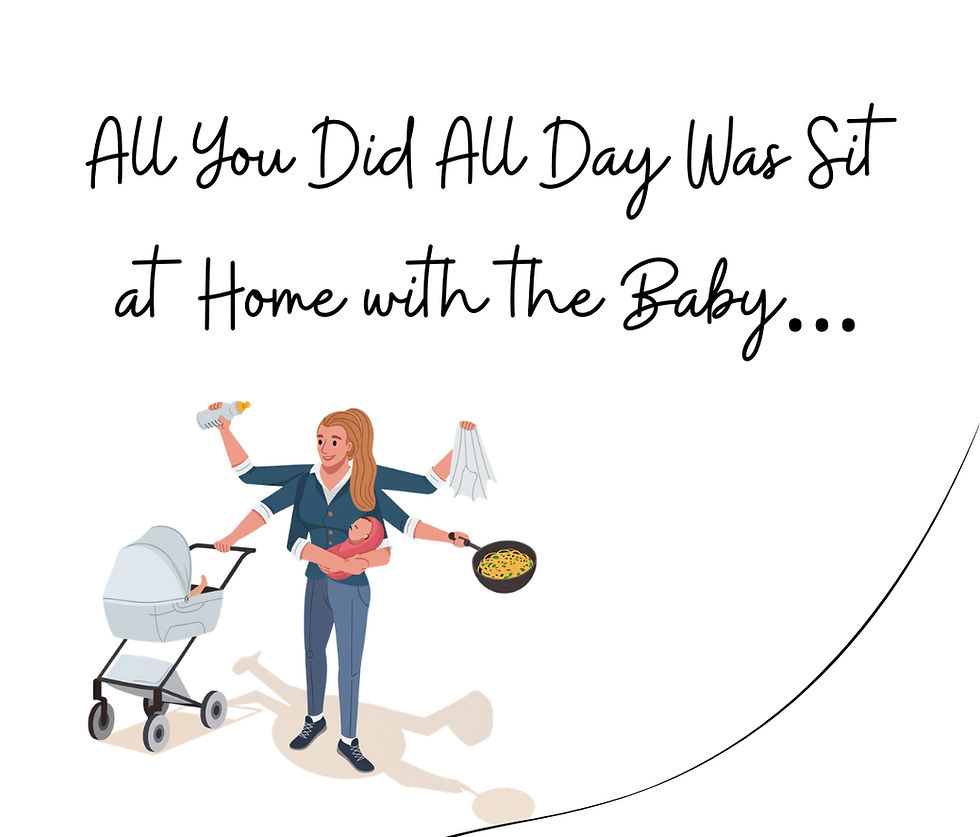
All You Did Was Sit at Home With the Baby...

Updated: Jul 2
Understanding the Challenges of New Parenthood
Having a baby can be an amazing, incredible experience full of joy and excitement. New parents coo and marvel at their beautiful new baby. Before having children, many couples discuss theoretical situations about how childcare will be managed. They talk about who will oversee what tasks or how they want to handle various scenarios with their children. However, once the baby is born, emotions run high. Lack of sleep makes decision-making almost impossible. Parents must adapt to their baby’s ever-changing needs. All those optimistic plans can get thrown out the window. Stress, irritability, and overwhelm can take over, especially when one spouse returns to work before the other (or at all). This introduces a new set of logistics and stressors. One common issue new parents struggle with is the notion of “division of labor.” This concept refers to how household and childcare tasks are divided.
The Transition Back to Work
When one spouse returns to work, their focus naturally shifts. They must re-navigate their job and the workplace. They put their “work” hat back on and recall how to function and succeed in their role. There is increased pressure to make money to support the baby and maintain the same standards as before becoming a parent.
The Exhaustion of Stay-at-Home Parenting
Staying at home with a baby can be exhausting. Here are some reasons why:
Constant Task-Switching
Our brains naturally want to conserve energy. They prefer to streamline tasks so we no longer need to think about them actively. For example, consider brushing your teeth or putting on your shoes. You don’t think about each step; your brain does it by rote. But when caring for a baby, you constantly switch from task to task based on what the baby needs. Primary caretakers face interruptions from cries, dirty diapers, and schedules that are often out of their control. This constant switching is harder on our brains and can deplete our energy.
External Expectations
Primary caretakers often face external expectations and judgments from others. Questions arise: Is the baby eating enough? Are they on the proper schedule? Have you baby-proofed the house? Are their clothes clean? Are you sleeping when the baby sleeps? People have opinions about whether primary caretakers are doing it “right.” It’s impossible to please everyone, and this pressure can be exhausting.
Differing Opinions Between Partners
Partners often have different opinions on how things should happen in the household. Even with discussions before the baby arrives, feelings and beliefs can change once the baby is born. What once seemed important may no longer make sense. If the baby has colic, reflux, or other health challenges, these require different approaches and logistics.
Increased Household Management
Managing a household may have been easy before having kids. However, once you add bottles, diapers, toys, equipment, playmats, baby clothes, and newborn gifts, the workload grows exponentially. Increased dishes, laundry, tidying, planning, and organizing make managing a household complex. It requires more awareness and forethought.
The Cost of Childcare
Childcare is often viewed as a natural part of having a family. However, if stay-at-home parents were compensated like daycare providers or nannies, they would likely earn a full-time salary. While one may be “saving money” by keeping a child at home, there is still lost income from what they could be earning if they were working outside the home.
Communicating Concerns with Your Partner
If you feel your partner is not as supportive as you would like after they return to work, it’s important to express your concerns early. It can be easy to dismiss or push away these feelings, but doing so may lead to bigger issues over time. Unfortunately, many moms find themselves needing to prove that caring for a baby is time-consuming, draining, and overwhelming. Discussing feelings of being invalidated, ignored, or dismissed is crucial in the early stages of a new family. Couples counseling can be a great space to address these concerns and work through challenges openly.
Strategies for Managing the Division of Labor
Here are some practical suggestions to help with the division of labor and the mental load:
Make the Unseen, Seen
Write down a list of all the logistics and thoughts occupying your mind. Ask your partner to help brainstorm ways to manage these tasks. This can foster understanding and collaboration.
Conduct a “Time Audit”
Go through your day and document everything you do, along with the time spent on each task. This exercise can reveal where there might be more flexibility than you thought and highlight how much needs to happen each day.
House Audit by the Non-Primary Caretaker
Have the non-primary caretaker walk through each area of the home. They should note what needs to be done, consider ways to improve or reorganize, and break down the steps for each task.
Establish On/Off Times
Allow each partner time away from the baby when they are awake. Take shifts for activities like showering, exercising, spending time with friends, or simply resting. This can help recharge both partners.
Trading Places on Weekends
On weekends, try to “trade places” for a few hours. The primary caretaker can leave the house for errands or personal projects. Set clear expectations that the baby needs care, the house needs tidying, and meals need preparation. Afterward, discuss the experience and its impact on the partner who stayed home.
If your partner is resistant to trying these strategies, approach the conversation with curiosity and without judgment. Understanding their feelings can provide valuable insight. In new families, a great deal of adjustment, communication, and trust is necessary for a smooth household. Patience, flexibility, and cooperation will help make this journey more manageable.
"Having children is like living in a frat house - nobody sleeps, everything's broken, and there's a lot of throwing up" — Ray Romano


Comments